

Jim de Jong, one of Rotterdam’s most remarkable chefs with a restaurant that might just be my favorite in my home town. With internships at Le Cirque (Robert Kranenborg) in The Hague, The Fat Duck (Heston Blumenthal) in London and at Le Jardin des Sens (Pourcel brothers) in Montpellier he gained quite some experience.


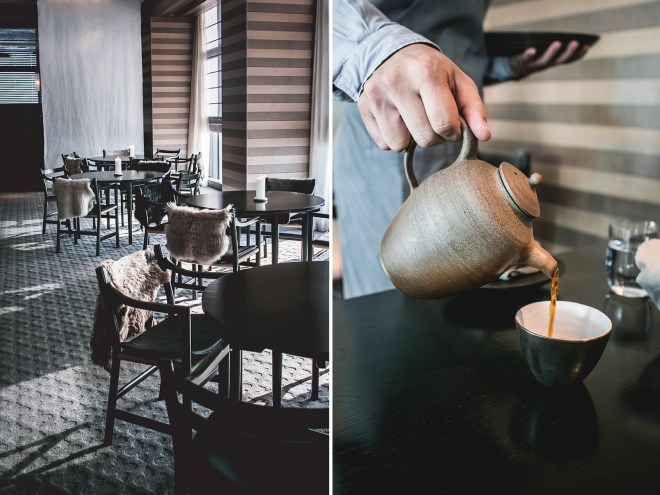
At the age of 21, he opened his first restaurant together with his former partners, called De Jonge de Jong (nowadays De Matroos en het Meisje) but a few years later in 2013 he started Restaurant De Jong on his own. With a little help from his love (who works there as well) he created this gem in the Hofbogen, a former station. A romantic French touch, Scandinavian simplicity and Dutch no-nonsense influences can be found in the interior as well as in the food.
You can choose from two surprise menus, one of them is based on vegetables and the other one includes fish or meat. The dishes change constantly and Jim is not afraid to get a little experimental in his kitchen. But there’s always a solid grounding to his dishes. The base is mainly French but Jim always tries to stay up to date and does a lot of research. His dishes, his menu and his way of cooking are a melting pot of advanced and old techniques, other traditions and his own Dutch tradition as well. From preserving to liquid nitrogen, Jim doesn’t have any boundaries, he’s not bound to one certain style. A starter might look and taste like something you’ll eat Noma, in your main course you might find some El Bulli influences and the dessert that will follow can make you feel like you’re in a French bistro (with some added edible glitter). I had my best ‘Moelleux aux chocolat’ ever at De Jong.
Like many restaurants nowadays do Jim also works with the seasons and uses local ingredients. He forages in nearby woods and he has his own garden where he grows herbs, flowers and vegetables. He uses a lot of the flowers in his menu and not just for the looks but always essential to the dish as well. So don’t take them off!
With his Rotterdam spirit and his beautiful complexe simplicity, Jim knows how to pleasantly surprise me every time. It’s not a traditional restaurant, you’ll eat what the chef has in mind for you that day. I think he’s the coolest and most talented kid on the culinary block of Rotterdam. Adventurous, humorous and beautiful feel good food is what he serves. Just love him cause he’s not afraid to take risks.
Go there, be open to what the evening will bring you and get surprised.

Raampoortstraat 38, Rotterdam
 Yesterday was Noma’s last service in Tokyo. A reservation waiting list of 60,000 people, but we were one of the lucky ones. The happy dance we did when we found out we got ourselves a table was followed by a few months of waiting. Longing..
 Who thinks Noma uses ingredients like this just to shock you is wrong. It’s the essence of what food is about and it’s surprising to notice how things like insects and living animals are not integrated in the (mainly Western) kitchen yet. When our food still has eyes or is still moving we get frightened even though slurping fresh (alive) oysters is nothing new to us. Many chefs claim to be local and sustainable nowadays, but 100% local in Copenhagen means no use of some basics as black pepper or citrus to season the food. This is where the ants come in and bring similar flavors. After reading Rene Redzepi’s diary I learned his inspiration to use ants came from Brazilian chef Alex Atala and the diary made me understand, appreciate and respect his vision and his work even more than before. I would recommend everyone interested in food and/ or creativity to read it. Just like in Copenhagen the next dishes rapidly followed to keep our focus on the food.


 My personal favorites: The citrus and long pepper dish: a variety of different Japanese citrus (suntan, Hassaku, Mikan and Iyoukan), drizzled with kombu infused wild sesame oil and garnished with Sancho and pipātsu (sliced long pepper).
 Redzepi’s treatments on the food were totally respectful of the Japanese tradition but he took them into completely new dimensions. He is always challenging himself and his team to go beyond and even though he’s got the best restaurant in the world he’s still learning and trying to get better. The temporary restaurant in Tokyo could be seen as a step to take Noma in Copenhagen to the next level. Meanwhile, in Japan, he has been a big inspiration for local chefs and customers to go beyond the confines of Japanese tradition. This was a huge succes!


 About Me